
““Get out of your head, and come to your senses.””
“The past is never dead. It’s not even past.””
The body remembers.
From the moment we are born, we meet the world through sensation. As infants, we are rocked, soothed by song, feel joy ripple through us, and are comforted by the rhythms of a heartbeat not our own. We begin in an embodied relational space, connected through movement, energy, and presence.
As we grow and develop, we carry those early rhythms in how we hold ourselves, how we move, express, and protect. We are often taught, directly or indirectly, to silence big feelings, to behave, to suppress. But the body keeps remembering and attempting to speak. It clenches, trembles, softens, and expands. It tells the truth even when the mind is not present to listen, or when fear leaves us disconnected from ourselves.
Our bodies and minds are in constant conversation. What we feel can shape what we think. What we think can shape how we feel. This flow moves in both directions: from mind to body, top-down, and from body to mind, bottom-up.
Talk therapy often begins from the top down, helping us understand and organize our inner world. Healing and change can also arise through being in the body, through sensation, breath, movement, and awareness.
In body-centered, or somatic therapy, we listen to the subtleties of the nervous system: the gut feelings, the tight throat, the heavy chest, and begin to understand ourselves from the inside out. Trauma often lives in the nervous system and can show up through habitual responses such as tension, hypervigilance, shutdown, or overwhelm. By noticing and gently meeting our emotional world through the body, we can begin to cultivate greater compassion, regulation, and resilience. This awareness can help restore and rewire, so we don’t just survive, but live more fully, honestly, and freely.
Science shows that tuning into the body awakens parts of the brain linked to empathy, kindness, and connection. The more we feel ourselves, the more we can feel with others.
The body holds our life experiences and remains in close relationship with our emotional world. It responds to what we feel, what we have lived through, and what may still be asking for our attention. The body does not lie. It holds memory and trauma. It holds pain, fear, hypervigilance, shutdown, resilience, and becoming. The body carries layers of our experience and is constantly changing as we take in and interact with the world around us. It is dynamic and always in process, even in stillness.
I offer a space to explore this embodied wisdom, especially for those navigating trauma, anxiety, depression, disordered eating, or a disconnection from self.
Drawing from somatic movement, body-mind psychotherapy, and the Ilan Lev Method (ILM), I support arriving at presence, curiosity, and self-compassion. I work with gentleness and deep listening to your body’s unique rhythms, tensions, and movement, supporting you to reconnect with your body’s intelligence so you can feel more integrated, more alive, and more at home in yourself.
Ilan Lev Method (ILM)
Reflections on ILM: https://substack.com/home/post/p-204312781
I am a graduate of the basic course of the The Ilan Lev Method. This biodynamic movement and energy based bodywork is both releasing and opening somatically. ILM invites through incorporation of Feldenkrais principles a bodywork that encourages physical sensations of release of unwanted pain and tension, to allow for more space, expansion and freedom to be more present and embodied.
In an ILM session, the client rests on a low treatment table and is invited to surrender into the support of the session. They may lie on their back, side, or stomach, or sit at the end of the table. The practitioner is also engaged in an embodied process, attuning to their own body, finding ease and joy, listening deeply, noticing, and allowing space and play for whatever may arise.
Through touch and movement, the session becomes a dialogue between bodies. Patterns of holding are gently met with attention, curiosity, and responsiveness. Spirals, rocking, and travelling movements often emerge throughout the treatment, helping to bring mobility and flow to areas that may feel tense, compressed, or stuck.
The work can feel soothing, playful, and deeply regulating. There is noticing, pausing, holding, and listening. These qualities create space for tenderness and release, while supporting the nervous system to settle and reorganize.
In this way, ILM offers a kind of developmental healing through movement, play, and imagination. The body is invited to reconnect with its own natural intelligence and capacity for change.
ILM and somatic psychotherapy can work beautifully together. While somatic therapy helps bring awareness to emotional patterns, nervous system responses, and the meanings we carry through lived experience, ILM offers the body a direct, embodied experience of movement, release, and reorganization. One can help create language and understanding around what is being felt, while the other offers space for the body to shift and respond in its own way.
Together, they can support a deeper sense of connection between body and mind. As awareness grows and the body begins to soften and reorganize, many people experience greater ease, emotional resilience, and a renewed sense of feeling grounded and at home in themselves.
““Research has shown that the more a person is aware of their own body, the more their insula lights up in an MRI. The more active their insula is, the more empathetic they are to other people, which is the foundation of compassion and loving kindness.” ”
““There is more wisdom in your body than in your deepest philosophy.”
”
“...breathe in very deeply and connect with the feeling, and breathe it out on the exhalation. I call it compassionate abiding. It means staying with yourself when, probably for your whole lifetime you’ve always run away at that point.”
”
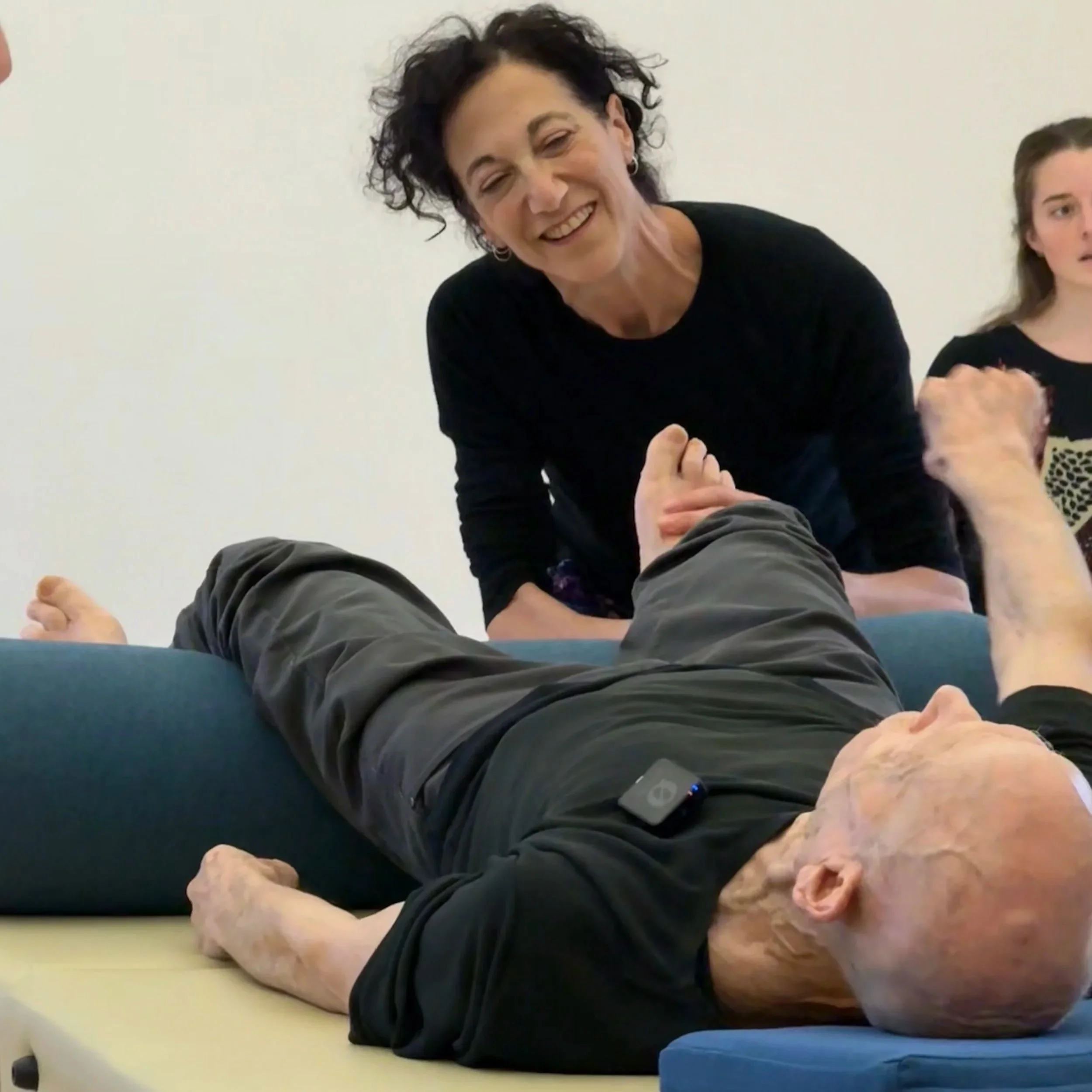
Image: Kathryn Samaras
An ILM training.